Every Sunday Morning, a place where various things get thrown out, shot at, cut open, and dissected. Topics of interest: psychological, and medical anthropology, privatization, globalization, excess, language, humor, hip-hop culture, jazz, brain and mind, memory, urban space development, Los Angeles, the Chicago Bulls, UCLA Bruins, FC Barcelona, and mankind.
by B.J. on 6/23/2008 11:16:00 PM
0 commentsPrint this post
The Manhattan Institute's John McWhorter says that hip-hop is not a vehicle for positive change, but rather a destructive force for black Americans.
Another one of those "reformed" black guys who act as a vehicle to legitimate conservative, and moderate white America's history of racism and paternalistic, third-person omniscient solutions.
I generally can't get myself to like anyone who can easily dismiss something that is important to a chunk of the population. He seems to goes out of his/her way to hate on something he doesn't really understand, kind of like a spy...or...a stalker. He reminds me of Steve Bowman's piece "You know what's stupid? Everything I don't understand!"
However, upon reading more of McWhorter's material here and listening to an NPR interview, I can't help but feel sorry for the man. I truly do.
Why? Two things: He's a stalker and he's passive-aggressive.
1) Keeping true to that identity as a stalker, he doesn't actually speak to anyone to uncover any truth.
In his main article against hip-hop, he leads with an observation about some kids at a KFC. The kids are loud and annoying in a public or quasi-public space, behavior virtually unheard of from any group or subgroup of teenagers in America. So, what's to blame?
You guessed it! The ASSUMED soundtrack of their lives. These Black kids at KFC...must be that damn Hip-hop! A-HA!
In his radio interview, he mentioned that when he speaks, everyone has been supportive and no one has bothered him. No one, except maybe "one hothead" gets riled up at his talks, probably because he bores his supporters or would-be supporters and he passively aggressively hides from those who want to call him out.
2) When explaining his avoidance of opponents and potential detractors, he calls himself a "homebody", code word for divorced-from-reality, scared, linguist.
I feel bad for him mostly because behind the flowery high-falutin' language and the degrees from Stanford and Berkeley is just a scared, passive-aggressive stalker.
Even though the writer of these books and articles is kind of pathetic in his attempts to disparage hip-hop, what he says is essentially still the same stuff that critics of hip-hop from casual to extreme haters use, so its still worth a response.
I can agree with a few things he says:
-Some of the most promoted and commercialized are those without real positive messages. But I can see where it comes from and I don't think it goes anywhere. -I agree that we could do without the sexism and violence but they'll keep saying what they want to say -People do need to adapt to their life circumstances
Where he and I differ is that he seems bent on extracting the worst elements of hip-hop and subsequently, rooting it out based on that.
It's kind of like trying to ban Christianity because you don't like the KKK or Terry McVeigh. In each case, you're trying to look for the worst elements of something you don't like without fairly weighing its good elements.
From this vantage point, this attempt to extract the worst of the genre, his argument boils down to two things:
1) According to him, Hip-hop is responsible for the destruction of the black American.
You'd think that the arrival of hip-hop caused the destruction of the 'hood.
"The rise of nihilistic rap has mirrored the breakdown of community norms among inner-city youth over the last couple of decades. It was just as gangsta rap hit its stride that neighborhood elders began really to notice that they’d lost control of young black men, who were frequently drifting into lives of gang violence and drug dealing. Well into the seventies, the ghetto was a shabby part of town, where, despite unemployment and rising illegitimacy, a healthy number of people were doing their best to “keep their heads above water,” as the theme song of the old black sitcom Good Times put it."
He seems to operate on this romanticized and historicized viewpoint that the 'hood was a rough place but still a place where this "healthy number" of people were doing their best.
Healthy numbers?
I remember a talk with the LA Times Homicide Blogger, Jill Leovy where she said that the black man murder rate has always been staggeringly high from Jim Crow until now. Her point was that there's deep a history of homicide within the black community.
In 1976, before talks of handguns, gangs, crack stuff, the black male homicide rate according to the US Justice Department was still 7x higher than those of whites. In, 1960, according to the Centers for Disease Control, death rates for black man were 14x higher, and in 1950 black male death rates were 17x higher than those of whites.
So bad things were still happening before hip-hop. I think the only difference with hip-hop in the picture is that it gives people like him to pick at and justify structural injustices and hegemonies.
2) His conclusion: hip-hop is antithetical to "helping people help themselves..."
He takes aim at those who try to spread the positive messages. Cites the Dead Prez as an example of conscious hip-hop. He mentions that they're pretty good at noting the insufficient employment opportunities. But he criticizes them for advocating civil and social rights, i.e. standing on top of Capital Hill.
The classic pull-by-the-bootstrapping man, he advocates a personal anecdote to a social and structural problems. He says that plenty of UPS jobs and delivery boys do not require college degrees and they can live perfectly legit middle-class existences. Guess he missed the talks about the disappearing middle-class, here, here, and here.
McWhorts then goes on to criticize those who do try to make their money in the underground economy. I would've thought that he'd think the underground is the adaptive way of making money, and would've applauded them.
Ultimately, Dr. McWhorter's prescription for his fellow black man is a whole dose of mediocrity. He offers a hellvua lot less that than the rappers from the neigbhorhood with the money and the women. He's essentially telling them to become drones of everyone else while other people get their action.
In the end, rap and hip-hop is only a medium of expression. It's a piece of marketing, but it doesn't drive any widespread violence that wasn't already endemic. If people want to destroy, that's usually a highly personal decision. I doubt that people make negative life or death decisions based on what they hear from an artist.
Hip-hop is mostly a tool for empowerment because it breeds expression. It has the potential to inspire. A tool for empowerment because this is where people can find their strength.
But ultimately, it's only a tool, it's not going to be the only thing that will make or break a segment of the population.
Spent most of undergrad criticizing the sciences in a minor that I thought would be devoted to just that.
But here I am, 2 years later, needing to learn it...
I bought the book In Search of Memory by Eric Kandel because:
a) I had been given a 2nd Barnes & Noble Giftcard thanks to my friend Nancy b) I figured I would probably take a class in auto repair...(or just rent a book from the 'brary) c) I wanted something that would encourage my interest in memory studies d) I didn't want something that I felt comfortable with and could read in an entire day
Yes, I've figured out something specific...I like the brain...and specifically I like memory.
Memory, because of its multifacetedness.
Short-term working memory has implications for intelligence, which is what I've always been interested in. Long-term memory shows what really lies deep within ourselves. Memory is a reflection of what we give meaning to, what we place importance on. Highly emotional, highly subjective states are what we remember most, because they are packed with meaning, and ultimately that's what we go on.
Overall, I didn't understand a lot of the biological language, but certainly, I became more interested in learning about them. I was interested in the insights he had into the science profession, the mind. Generally speaking, it's stuff you've heard before in the public discourse...our brains are plastic, you can learn a lot no matter what age you are, just in more detail.
On the book's interesting points:
1) Interesting stuff he said about the work of scientists.
First was a comment on scientific research work. He often described those he held in esteem as "creative", as if they were artists, rather than neurological or molecular biologists.
"There are scientists...who are very strong technically but who do not necessarily have the deepest insights into the biological questions they are studying (68)."
Then he mentioned the motviation of scientists; they are no different than any other human beings.
"If pure scientists were motivated by curiosity alone, they should be delighted when someone else sovles the problem they are working on---but that is not the usual reaction. Recognition by their peers and esteem come only to those who have made original contributions to the common stock of knowledge.(68)"
Scientists have a need to prove and validate themselves just like any other human being. However, the specialized, high-level language they use to describe their work, their findings, etc. makes it appear as if they are disconnected from the regular world.
2) On Learning: "Different forms of learning give rise to different forms of memory." (198) I have no clue as to what he's referring to here, but it could be interesting some day.
3) On Synapses and Learning: He mentions the strength of synaptic connections as being the key to learning.
Very important chapter in the book of neuro-bio for unbelievably moronic wankers.
"We found that learning leads to a change in the strength of synapctic connections---and therefore in the effectiveness of communication---between specific cells in the neural circuit that mediates the behavior.(200)
Strength---the long-term effectiveness of synaptic connections---is regulated by experience. This view implies that the potential for many of an organism's behaviors is built into the brain and is to that extent under genetic and developmental control; however, a creature's environment and learning alter the effectiveness of the preexisting pathways, thereby leading to the expression of new patterns of behavior.(202)"
He connects the idea that we have built-in knowledge to Immanuel Kant as opposed to John Locke's tabula rasa.
4) On Synapses: "Synaptic connections between two neurons can be...strengthened or weakened---by different forms of learning. Thus habituation weakens the synapse, whereas sensitization or classical condition strengthens it (204)."
So from this it sounds like habits make you have less synaptic connection because the synapse grows in itself, which means weaker connections between neurons, which means less likely to associate with another thing, which means that your habit becomes more engrained and exaggerated.
In contrast, being sensitized to something means stronger synapctic connections between neurons, which means more likely to associate with another thing, which means that your sensitization and association becomes more engrained and exaggerated.
In conclusion, associative and explicit learning arises from sensitization, while implicit learning arises from habituation.
5) On Neuro-bio: "Long-term memory required the synthesis of a new protein (212)." As opposed to the electrical charges that keep firing from neurons.
6) On Science and Evolution: Evolution does not have any higher purpose than its immediate adaptation for something.
"Evolution does not require new, specialized molecules to produce a new adaptive mechanism" (234).
...The Biochemical actions underlying memory did not arise apecifically to support memory. Rather neurons, simply recruited an efficient signaling system employed for other purposes in other cells and used it to produce the changes in synaptic strength required for memory storage.
7) On Evolution and Neuro-bio: The stuff that makes us what we are...our genes are ALSO subject themselves to the environment in which they live (264).
8) On Memories: A characteristic of age related memory loss is the inability to consolidate long-term memories (266).
9) On Synapses and Memory: The growth and maintenace of new synaptic terminals makes memory persist (276).
10) On Perception: Sensation is an abstraction not a replication, of the real world (Mountcastle via Kandel 302)
11) On the Hippocampus: Hippocampus is concerned with perception of the environment and represents a multisensory experience (308).
12) On Dopamine: Blocking dopamine blocks the stablization of the spatial map in an animal (313). Dopamine seems like the chemical for explicit learning and memory whereas serotonin represents the chemical for implicit learning.
13) On the Amygdala and Hippocampus: "Damage to the amygdala, which is concerned with the memory of fear, disrsupts the ability of an emotionally charged stimulus to elicit an emotional response. In contrast, damage to the hippocampus, which is concerned with conscious memory, interferes with the ability to remember the context in which the stimulus occurred. (342)"
14) Depression compromises the memory (361).
15) What science lacks are rules for explaining how subjective properties (consciousness) arise from the properties of objects (interconnecte nerve cells) (381).
Reflections:
1) On learning: As he was talking about studying analogs of learning, I was thinking about how people in general, learn. I think at the most ideal level, we learn by figuring out meanings. And then once we "learn" that it means something, we commit it to memory.
He mentioned habituation, sensitiation, and classical conditioning as the basis or most primordial form of learning.
2) On Habituation: Then I began thinking about habituation in my own world. The cycles of the world. I began thinking about the habits of people in the housing developments. What were their habits? What are the habits of the people in the middle and high classs? How did they develop them? What was the geography and environment that forced them to exhibit those habits that they did have?
3) On Sensitization: Then he mentioned sensitatization, and I began thinking about that in my own world. "After hearing a gun go off, a person will show an exaggerated response and will jump when he hears a tone or senses a touch on the shoulder (169)." Essentially, the gun going off acts as a sign and/or a symbol for someone to elicit a response.
4) On Brain studies of the past: I was curious about how this idea ever made sense in American Education in the 1950s:
"We were taught that the map of the somatosensory corex discovered by Wade Marshall is FIXED and IMMUTABLE throughout life." When and why did they think that it was fixed and mutable (216)? Was that informed by religion?
5) On Hippocampus and Spatiality: I also wondered about the hippocampus and spatial information that he mentioned(282).
6) On Intelligence: I was wondering how this fuses into Jeff Hawkins theory of brain and mind in his book On Intelligence.
7) On Fear: Fear is the easily most detectable emotion across species (339). It seems as though this is the emotion that what we give most the meaning to, and so we respond accordingly. It's really a disjointed event from anything were used to, so were likely to give a response out of the ordinary.
He brings in a dose of the breakthrough psychologit William James:
"We do not experience fear until after we have run away from the bear. We first act instinctively and then invoke cognition to explain the changes in the body associated with that action." (340)
Essentially, what he says is that emotion happens afterward, after an event. After the event is finished we build meaning off of that emotion via language expression which is then encoded into our memories.
8) On Learning: I began thinking of the social/asocial aspects of learning.
Learning is a very social activity, and that social activity is one way we build meanings. Learning in isolation is the most fruitful, but it's very difficult because we don't have the benefit of other people affirming your correctness in a belief or whatnot. You're forced to come up with your own meanings, definitions, labels for things and events which might be valid, but might not be recognized by anyone else.
Example: I watch a bunch of NBA basketball, but since I don't really have cable, it's often over the internet via international TV where they're speaking some other language other than English. So I don't watch a lot of basketball in English, which is good.
I don't have annoying commentators like Jeff Van Gundy telling me, indoctrinating me, on how unathletic, but intelligent the whiteboy Kirk Hinrich is, I just see what's on the basketball screen and make meaning out of what's happening all by myself. Therefore I learn what's happening in isolation, relatively speaking vs. other fans. I gain my knowledge of the game by my own observations, interpretations, and analysis. I "learn" what's happening basically on my own.
Realizing that I can learn either socially or asocially kind of annoyed me. Institutions seem to have a monopoly on social learning and will charge the hell out of you just for that. If you're not learning via an institution (and paying at least 20 dollars a unit), you feel like you don't know any avenue to learning what you need to learn.
The library is there, but it's limited and you still wouldn't know where to look.
But I digress.
9) On the feelings of disjointedness vs. fluidity: From Leo Tolstoy: "Happy families are all alike; every unhappy family is unhappy in its own way" (349).
From this quote, I became concerned with the idea of disjointedness in the unhappy family and explicitness vs. fluidity and implicitness in the happy family. Everything seems to be a disruption for the unhappy family whereas, everything seems to work in harmony for the happy family.
The discourse about the unhappy family, and explicitness triggered personal memories of the kids in the housing developments yet again. What types of disjointedness have they experienced and how have they dealt with them? I would think a quality of disjointedness towards long-term ventures, not because it's innate, but because it's been learned.
10) On Working Memory: "When normal individuals are challenge by a task that requires working memory, metabolic function in their prefrontal areas increases dramatically (354)."
Working memory seems to be a tool of social moderation --- they say "intelligence" is just working memory, and prefrontal areas with which it is associated with are associated with planning and judging.
Doubts and Questions:
1) On Kandel's Observations and Reductionist Methods: I wondered if Kandel just colored in stereotypical sexist interpretations in his interpretation of results for the differences between male and female brains.
"He [Some scientist named O'Keefe] has found clear differences in the way women and men attend to and orient themselves in the space around them. Women use nearby cues and landmarks. Thus when asked for directions, a woman is likely to say, "Turn right at the Walgreen's drugstore, and then drive until you see a white colonial houe on the left with green window shutters. Men rely more on an internalized geometric map. They are likely to say 'Drive five miles north, then turn right and head east for another half mile.' Brain imaging shows activation of different areas in mean and women as they think about space: the left hippocampus in men, and the right parietal and right prefrontal cortex in women. (315-316)"
That's pretty much a hegemonically sexist thing to say: women are the fluffy, artistic, right-side thinkers, while males are the logical, left-side thinkers.
I consider myself a male and masculine and all that other shit, but I definitely don't give directions like the cold hard-cut logical male. I currently don't have the means to argue against what he says, but I just know that what he says doesn't seem to represent the truth.
2) On Kandel's Memory and Perception of this growing epidemic of "disorders of memory"...disorders of memory are more evident today than they were when I began practicing medicine fifty years ago because people are living longer now (327)"
This brings up other questions related to medical anthropology and health care that cut across time and space.
Perhaps more people are just diagnosing more, prescribing more, just to make more money, which gives off the feeling that "disorders of memory are more evident today."
After all, the guy is in the pharmaceutical biz...
Also, people probably are living longer, but how is he sure that a connection can be made between the fact that there are more memory disorders and a longer life expectancy?
Now's time for some of the best videos on the subjects.
A short clip of music: No on 98
40-Second Clip on Prop 98
The Organizing around Props 98 and 99
Investigating the Destructiveness of a Yes Vote on Prop 98
Key phrase from the last video: [A Yes on 98 Vote means] We will be faced with insurmountable economic burden."
Prop 98 in the Bigger Scheme, Bigger Picture of Things in Cartoon from SAJE!
SAJE Video on housing and condominium conversions in Los Angeles
It's really quite appalling how greedy and disconnected people are. Making way for luxury housing when they already have all the options in the world, while displacing those who don't have any. Luxury housing? Fool, we need necessity housing!
Anthropology has a history of leading the charge in chastizing "other" cultures for breeding "undesirable" attitudes.
When I say this, I have in mind Oscar Lewis' "Culture of Poverty" in which he uses the same judgmental terms as the "dominant" society uses to characterize low-income folks. He only defines these low-income folks based on what they do NOT have in comparison to the non-impoverished classes. He calls their living conditions "marginal", and makes the conclusion that they do not have a "cosmopolitan world view."
This paper probably touched off a chain reaction or chain web of events. It contributed to the Moynihan Report, a report by the liberal senator Moynihan whose report put a focus on the deterioration of the black-American family. This focus on the division and disintegration turn was something that Ronald Reagan seized upon in his campaign ads. Born was the stirring image of the welfare queen and its partner-in-crime, the self-help, pull-yourself-by-the-bootstraps discourse. I really wish someone would vandalize or burn that man's library in Simi Valley. LA Graffiti and gang violence...talk about your complete misplacement of energy and efforts. Crips, Bloods, Truchas, Mafia, Mobsters, 18th Street, Triggs, Wa-Chings, Maravillas there's a property on 40 Presidential Drive, Simi Valley, CA that needs some claiming.
But I digress.
The point is that once "poverty" became a "culture", as if it was a way of life people "chose", it became easy for regular people to say that those low-income people should simply "not choose" that way of life. As a result, anything associated with the black family just became lumped and interrelated with each other in popular discourse. Blacks in poverty? Easy, you can blame that on the fact that most of them are lazy and don't have a father figure.
People outside of academia have generally failed to look at root causes or look further into to why they've made the observations they've made. Unless they have been in the culture and/or they can understand or even make an attempt to understand, people did not and generally still do not take the extra step to look into what makes so many of them lazy and/or even better, what supplants laziness, what they are not lazy in, and/or why it appears they are lazy.
If anthropology can criticize "others", the field of anthropology can lead the charge in chastizing "this" culture for breeding "undesirable" attitudes.
My first course in Psychological anthropology asked the question of whether or not "culture" can make someone "sick." Even though I had been an anthropology major for 2 years to that point and not having been a fan of the perceived dominant tenets of American culture since a high school history class, I had never thought of this question.
And so now in an era of Roger Clemens and Barry Bonds using steroids, Olympics stars like Marion Jones going to jail for using drugs, and the sport of cycling being dented every year because of some kind of drug scandal, what does this say about us and our most prominent cultures of excess and poverty?
However not to be completely mudslinging at these dominant cultures, and to differ a bit from their approach, maybe we should also ask, what are the root causes, and what gives people so much opportunity and space to consume what it does in excess?
Another question separate from focusing on the culture of excess but rather the culture surrounding "enhancement" is why there is such a moral code and imperative ascribed to sports as opposed to none whatsoever in the fields of academia or medicine? We don't care at all that a seizable chunk of them take brain enhancers. No one would call that "cheating." The Onion makes fun of that fact.
They say "opportunity" is limited in low-income areas. This is what I wrote in many a grant proposal.
"Limited Opportunity" is code for not many decent jobs, decent schools, etc. "Decent jobs" is code for legal, stable, flexibility for promotion, and enough money to achieve a modicum of sustainable comfort. "Decent schools" is code for well-equipped, safe, undercrowded, good high school graduation rates
When we use the phrase or any variation of "limited opportunity", this is what were saying: the best paying jobs are illegal and unstable, and either that or there aren't any jobs from which you can move up, give you advantage, or which make any sense to take. The schools are terribly equipped, unsafe, overcrowded, where just as many people drop out as graduate.
Limited opportunity --- risky or undervalued and overworked jobs, terrible schools.
I found it interesting that the sherriff used "opportunity" in a different way. In the context of which he made the quote above, he was describing how he was almost jacked because he looked aloof to his surroundings. Obviously, he meant "opportunity" in the broadest way possible, "a favorable or advantageous circumstance or combination of circumstances."
The robber saw an "opportunity" to take his shit because he was alone and looked aloof to all his surroundings. It wasn't random.
This made me think, people will see different opportunities all the time, given what they grow up with, their experience and their knowlege.
Plenty of white people coming from Spain, England, France, etc. saw opportunities to convert more people to their religion and make money by jacking American Indians of their land. Perhaps coming from what they considered to be crowded and restrictive places with hierarchies, combined with knowledge of farming methods, they saw an opportunity to get their own land, and make their own industries in an entirely different land.
If you see a vulnerable person, either physically and/or mentally unimposing, you're almost pre-programmed to take advantage or create opportunity for yourself, whether you're going to steal or sell something to someone. I'm not sure if that's an American-specific or mankind type of feature. But if you see this opportunity this is informed by your assumption and expectation that this person does not have the capability, physical or mental, to resist what you are doing to take his/her resource(s). This is what we see in business anywhere in America whether the corporations posing as individual people and trying to make money off of everything including the air we breathe to gang-bangers extorting money from cart vendors.
These are all opportunities seen and taken by individuals and groups of people.
So perhaps there is no lack of opportunity per se, anywhere, including low-income neighborhoods.
What we should say is not that there's any lack of opportunities, but it's a lack of positive, "legal" opportunities for folks in low-income circles. "Positive, legal opportunity" meaning not likely to lead to personal/interpersonal physical and/or mental destruction and endangerment. There's a lack of that.
I think what distinguishes "positive" from "destructive" is that positive doesn't include stepping on people (at least not as directly).
So by that logic, there's much more opportunity to do bad than do good in the hood. People do not intend to be bad when growing up, but if the opportunity is there, given what they learn in their primary environs with peers and family, they will seem to keep taking those opportunities in that direction, building their skills and knowledge in things that are not good.
If they become good at it, they've built up this expectation that they can keep exploiting these opportunities...that they have a modicum of invincibility, strength, a feeling that they've got it all figured out.
YES on the Homeowners Protection Act (HPA), Proposition 99
NO to California Property Owners and Farmland Protection Act (CPOFA), Proposition 98
I think it's critical to know the difference between the two eminent domain reforms that will be in California's June ballot.
The simplest act, Homeowners Protection Act, Proposition 99 is best and relatively straightforward. Vote Yes on it.
However, the California Property Owners and Farmland Protection Act, Proposition 98 is under the guise of eminent domain reform, but actually not...otherwise it would be the Homeowners Protection Act. Vote No on it.
With the California Property Owners and Farmland Protection Act (CPOFPA) Proposition 98, what they're trying to do is two main things:
1) Move towards the elimination of rent control and mobile home destruction.
2) Erode Environmental Protections for public water use.
Essentially what they try to do is capitalize on the hate for eminent domain going towards private development to say that: poor people are actually "private" entities and that the go
Before the actual initiative is introduced on their website this is was they say about private use:
"Private property may not be taken by eminent domain for private use under any circumstances (i.e. to build a shopping center, auto mall or industrial park)."
Focus on the word "private use."
They want you to think that this is all about protecting your house from being taken over by the government to be given to private developers.
In the actual document they are very smart to use the phrase "private use" only about twice in the entire document, but this is the key phrase.
"Private property may not be taken or damaged for private use."
And these are two key ways they define "private use"
"(ii) transfer of ownership, occupancy or use of private property or associated property rights to a public agency for the consumption of natural resources"
(iii) regulation of the ownership, occupancy or use of privately owned real property or associated property rights in order to transfer an economic benefit to one or more private persons at the expense of the property owner."
Just a use of the word "private use" already packs so much meaning for those with a hand in drafting the act, but such ambiguity to make it seem non-confrontational and thus appealing to an average voter.
The clause numbered "(ii)" is an attempt to make it difficult for government agencies to acquire land for public water projects such as reservioirs and other public water storage projects. Essentially, private property may not be taken or damaged so that public agencies can "consume" natural resources. "Consume" is another ambiguous word because that can encompass a lot of things.
This seems like the type of thing that will just open and strangle public water projects in litigation, all the while indirectly opening the market even wider for private companies "to come to the rescue" and start showing how efficient they are at privatizing water and profitting off your basic needs.
The clause numbered "(iii)" is the attempt to savage rent control and open mobile home projects.
Despite their compensations for being rent controlled properties, they're saying that the government putting regulations on how much they charge equates to the government basically using their property. No one told these people that they had to own land. It's not like these people with the power don't have a choice.
What this act is saying is that the government cannot regulate what property owners such as landlords and mobile park owners do in charging rent. If that were suddenly the case, it is likely that they'll work, jack and pump up those prices more than a 13-year old boy on summer vacation at home with a stack of material not meant for reading. All the folks who take on the lowly-paid jobs would be pushed the hell out of cities where the jobs are. Pushed out because there's no space to live anywhere.
At this point, if you're not sure about the act and it's always best to actually know what it is you're voting for, take a brief look at who else supports this act.
California Federation of Republican Women California Republican Party Riverside County Libertarian Party California Republican Taxpayers Association
Aren't these the groups that traditionally run against humanistic interests such as affordable housing and environmental protections?
Are these groups more tied with selfish, business and privatization interests?
Any tenants rights' organizations?
Any water agencies?
Are there any environmental groups you see?
According to California for Democracy:
"Wealthy apartment and mobile home park owners spent close to $2 million to qualify their deceptive rent control rollback proposition for the June 2008 ballot. The landlords are going to try to trick voters into believing their measure is about eminent domain."
They definitely paid people to make their bullshit hard to detect, so of course the language will all seem agreeable.
Everything that they write about seems to be good on the surface, but their game is, (and has been since some folks from Europa took land from indigenous people) about creating bullshit laws and finding loopholes to exploit till people take action to stop it, and/or till they can find more loopholes to create.
Are they going to come out and say "we seek the abolishment of rent control" or "we really don't give a shit about what we do to the environment just as long as we get money?"
It's not so much about what they do say, it's about what they don't say.
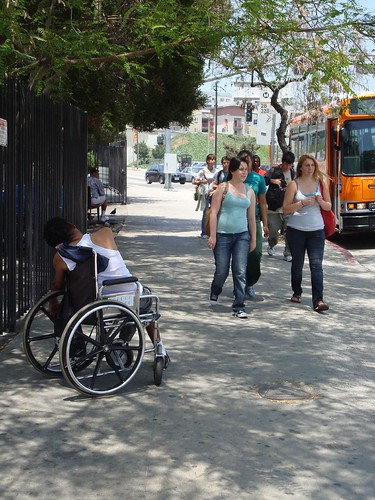
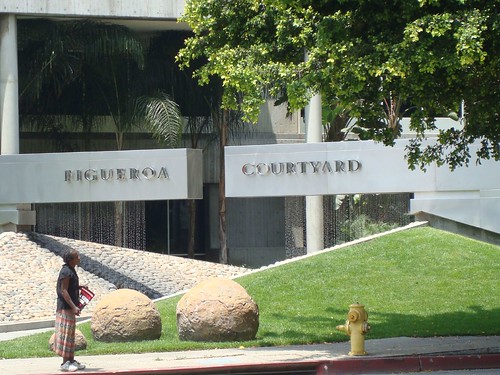
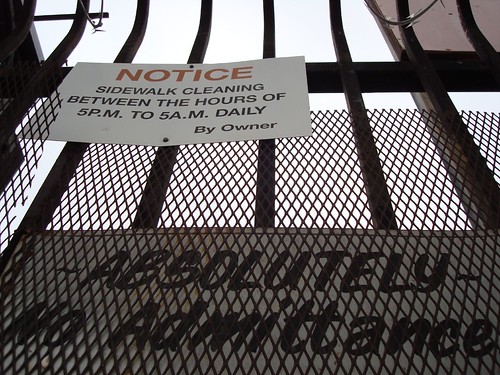
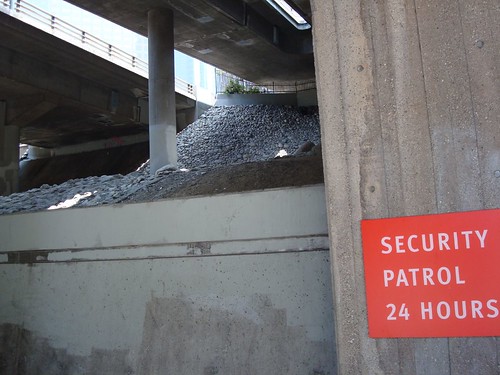
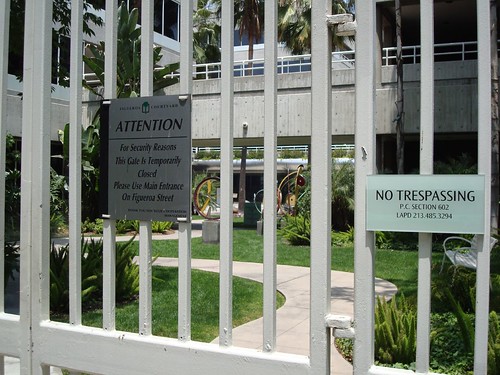
They have interesting signs, the finest in chain-link, steel gate, barbed-wire architecture complete with Orwellian surveillance.
So great is the attraction that many people stay outside to be near its ambiance. Very often people get so caught up in the scene that they fall asleep outside!
Sometimes, they'll even pitch tents just so they can take it all in at once!
People courteously letting an exhausted wheelchaired architecture enthusiast have his sleep.
Oh the vanity of this man!
If you wanted to lie down in an open space park, the steel bars provide more than adequate support for your lower lumbar's needs! It would give you this...elevated feeling!
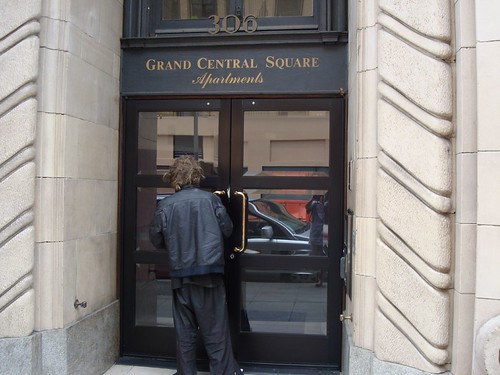
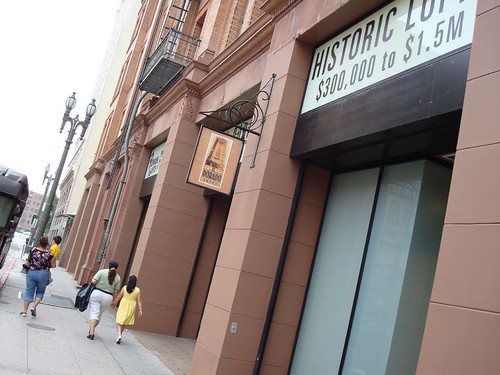
History is worth 1.5 Million dollars and this lucky family is afforded the opportunity to be near it!
Just like the Star Wars enthusiasts, only he's the first one there!
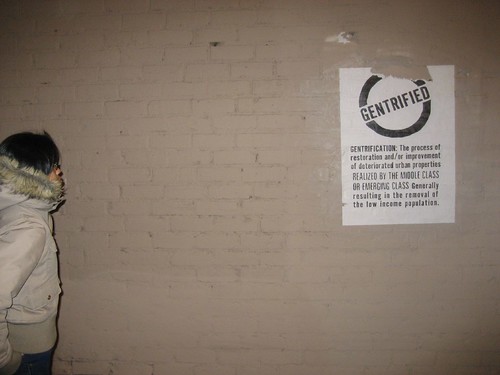
Oh boy, what will those creative souls in downtown LA think of next?
by B.J. on 11/10/2007 03:58:00 PM
0 commentsPrint this post
It's been quite a while since I last ran more than 10 miles.Today I wasn't going to be content just running the typical Sunset to West Hollywood usually through Beverly Hills and to UCLA, or Griffith Park Boulevard to Los Feliz through Glendale, or SilverLake to Fletcher through Eagle Rock route.
Those routes...too routine, and I have a sneaking suspicion that I won't ever be able to run a marathon in 2 hours and 9 minutes.
Instead, today I decided on going to downtown LA, and wherever else the road took me.
Started out gloomy and chilly enough by this Angeleno's Standards, which is why I handily wore my winter headband, which suckered me into believing that I was Rafa Marquez, the Barca defender and Mexican hero.
It was a day, a run where I saw how beautiful everything is...and how ugly things can get.
Ran across buildings that have been here since the emergence of LA as a big city 130 years ago.
Shook my head, mentally, with each and every luxury loft occupying tons of space, with the knowledge that Skid Row is literally a block away.
Ran across the Eastern entrance of FIDM. Wondered if the rich white females there would look at me, catch on to my Rafa Marquez headband. and call it the next big thing.
Visited a cool nonprofit that will and has served as my parking lot when I have to go to the Convention Center and/or Staples Center.
Had to see the old Alvarado terrace. There's a little strip of land, as part of Arnold's Parks act, that serves as a "park" with some authentic cobblestone roads. It's always interesting to see something that old.
Saw the old "S.Hoover Apartments" sign on this one building, that I always see when I drive down to this part of town. I can't make up my mind if the structure was built and the lettering was written around the 1890s or 1920s or somewhere in between or heck maybe even later.
Went through to Westmoreland, thinking how it was an enclave for LA's earliest elite, what they and their ancestors would think of it now.
Parused through the old high school. Or should I say "brand-spanking new" old high school. Seems like all anyone has to do to ruin things is burn down one general section of the school. No more street crossing to get to that building across the street, no more on-ground student center, no more sophomore lockers near Pinney.
One of the women I talked to said that it looks like a college campus. Yes, if you're a fan of the "institutional" look that Porter College at UC Santa Cruz sports, then you too might enjoy the new construction.
After that, I ran across some egregious examples of city planning on what was a route for the high school cross country team. The route stretches from Venice westward bound to La Brea. I never noticed how unwalkable it is. Jesus christ, or Councilperson build a fucking side walk!
In other news, "egregious" is rapidly emerging as one of my favorite vocabulary words to casually inject into normal conversation.I didn't realize how far La Brea actually was and could feel the urge to quit bearing down on me.
But I was so far from home that it would've probably taken a 4 hour walk to just to get back. So once I was up La Brea and crossing 1st street, I eventually gave in...5-6 miles to walk...and at a pace you can only expect after running more than 10 miles for the first time in months...without drinking any water, eating anything beforehand.
I'd have to walk up La Brea and wait for Santa Monica Boule to show up.
This is when the sun started to show up a bit more.
I wondered how and why the hell the surveyors measured La Brea heading West.
I saw orthodox Jewish people attending Saturday morning services. Kept wondering if they spoke English. Perhaps that's how some folks in Montana or South Dakota view Mexicans, Arabs, etc. Wondered if they had a myspace and if they would put a grainy self-taken picture of themselves in those suits. Wow, I am showing tons of ignorance, and I guess I know a bit of what it feels like to be one of those people mocking people of color.
Saw some nice graff work across La Brea.
Women with nice fat ischial collosities wearing pants to a point of tightness and you could see the outline of their little cloth (or possibly silk) coverings.
A frail-looking white homeless man offered to suck my dick.
Noticed a water shop on Santa Monica, and that they had dropped their prices for a gallon from 25 cents to 20 cents. Also noticed that Little Ceasar's was selling crazy bread for 2 bucks. Don't even know if the price has gone up or down, but pizza's only 5 bucks!
Saw a bunch of people in the Medical building where I used to go to the Dentist having some kind of conference breakfast or brunch. Still smelled pretty medical --- a strange enticing mixture of basementy and gassy.
Noticed that they've sandblasted a lot of graffiti in the spot leaning up against an Elementary school.
Along the way, I noticed a bunch of other things:
Lot of people working on a Saturday. Mostly the ice cream pushcart vendors, the fruit pushcart vendors, the day laborers at industrial buildings, the people making the comida at las restaurantes centroamericana, the ditch diggers, mass poster plastering. It's interesting how specialized a people we have become. We all do one thing at a time, hope to get paid well, and buy stuff. Yet, this might be changing given the way information is now sent.
I noticed that the areas had more space, the more West I went. Developers from the 1920s and 1930s at work?
I wondered if there were any straight houses in and around the Pico-Union, Alvarado terrace area. Pretty damn big for just families. This is probably something I could just find out by looking at a zoning map, but that can be a daunting task.
Saw private security guards telling homeless people to vacate the premises on several structures with lots of crap in it, usually with people who use paper to acquire the crap. Very popular around 99 cents stores and convenient stores in and around Hollywood, and soon, coming to a city near you!
Tagging is just through the roof nowadays. The Los Angeles mural painted by cache has a bunch of people trying to scratch on it already, and I think that was a pretty dope mural with some credibility, but some people obviously don't think so. Or perhaps Cache shouldn't dominate every damn wall I see in Echo Park and should integrate more folks in his work. I noticed on an affordable housing project, kids had already began tag-scratching it's doors. And that's been up for maybe only 2-3 years. A mural that is currently in work with a bunch of white people on it on is sure to suffer the same fate.
I built up a craving for sweet bread. Saw it first in Echo Park, saw it on Santa Monica, but nothing reasonably walkable, which sent me to thinking about the economic and demographic development of Silver Lake. Only the ever popular Pupusas, and Tacos...in restaurants allowed. No bakeries? One I see is a restaurant and some Filipino bakery.
I continue to be stunned at how people come here to be rebels or "different" and...shop, shop, shop...for furniture, vintage furniture, vintage clothing, shoes, gelatto, vegan crap, coffee. Shopping...the most undifferent thing you can do. The people in Silver Lake make me mad sometimes.
But all in all the day was pretty damn fun, more food for thought or perhaps a waste of time for some.
The road I took took me down Sunset to the borderline between Chinatown and downtown. From downtown to the Staples Center From the Staples Center to Loyola High school. From the high school to La Brea. And from La Brea to back home. It started out gloomy and chill and ended sunny and chilly. Ran through a mix of enclaves, with the businesses offered in English, Spanish, Korean, Armenian, Jewish, Tagalog. I thought about George Carlin's meme of how we've turned America into a mall. Thought about architecture, urban planning, race relations, personal relations, language, and the physiology of the brain.
In the words of Forrest Gump, I just felt like running.
But not without my Livestrong, Enriching Lives, Justice for Immigrants, and Serve the People wristbands.
by B.J. on 10/08/2007 09:59:00 AM
0 commentsPrint this post"You know why we have houses? It’s so we can keep all our stuff in them. And when we buy a new house and we have to buy more stuff to fill our house" - George Carlin
Born. Breathe. Eat. Drink. Shit. Fuck. Die.
I guess that sums up human existence in 7 words or less. I'm not really sure what else is supposed to happen afterwards, but from visual, auditory, and other sensory cues, it looks like that's about it.
Often times I have this craving to buy something to make myself feel better.
If I get this McDonalds' Sundae and consume it, my life will be much more complete.
Even though I will have added an unnecessary 400 calories to my diet. And will probably function at a slower rate.
But at least my taste buds will have experienced a temporary positive stimulation.
If I buy and spend time playing FIFA 08, even though there are approximately 34,734,833,743,829,347,384,323 things that I could do that would lead to something more useful.
These are amongst some of the most difficult issues I must deal with on a daily basis.
I take the perspective that I have been given a lot while others not so much. I juxtapose that belief with the classic maxim pressing my mind: with much power comes much responsibility.
The result? I've been trying not to give into excess and temptation. No dollar donuts, no eating out, no traveling or using the car if I could help it, limit computer and technology use outside of "work" to about 3 hours a day.
I call these things "excess" and "temptation" because they aren't really "needed" in the sense of the sustenance that simple water and food give me.
Giving into those temptations usually only temporarily satisfies some decidedly shallow desires.
It seems like when I do give in, it's only to make myself "feel better," as if some sort of balance will be achieved if I give into the temptation.
But then I realize something. Kids from Brazilian favelas playing soccer with home-made balls don't have this luxury.
In all likelihood, they don't have this similar temptation because they aren't exposed to it. In other words, they probably don't need to play FIFA 07 to restore some sort of balance to their lives. It probably isn't a part of their world, so it's not going to help restore some kind of balance for them. For that matter, they probably also don't need an In-N-Out cheeseburger, a Diddy-Reise chocolate chip cookie, a bottle of Heineken, thai BBQ chicken, an iPhone or iPod, 20-inch rims, to restore a feeling of balance. Parents from these favelas probably aren't taking their kids to Disneyland or even movie theatres to elicit a sense of "fun."
It would be interesting however to find out what they do actually need to live balanced lives, and how the powers that be has probably limited access to it.
In conclusion, if it's simply this feeling of balance that needs to be achieved whenever one needs to consume and engage in their brand of 'fun", can't the American human middle-class mind find a way to self-engineer it without spending money? Or are we hard-wired to consume?
The freegans are a group of people who attempt to live off what people throw away, be it abandoned buildings in your city, food, or electronics. What strikes me is that they are independent people, somewhat free from the system. It seems that they get their enjoyment out of "foraging"/finding things and making something out of it.
To me it seems like the feeling of balance is achieved when you are in a similar situation and do exactly that --- independent and making something out of nothing (or whatever is perceived as nothing). The balance seems to happen you are free from the need to sustain a string of short-term pleasures like buying a new car or even consuming a chocolate bar, and keep control of your mind.
If you're an individual, you must be selfish and focus only on what you can do in society.
What the fuck. Thanks Ronald Reagan and the new conservatism and exaggeration of poverty. (Someone please collectively pistol whip the idiots who make Reagan Revolution shirts in the mold of Che Gue)
I feel like the distinction must be made, over and over, especially to Disneyland America. Here it is:
Being an "Individual" means doing things on your own power, doing unique things by themselves, but necessarily excluding working with other people, while locating your own meanings.
Selfish is a trait that assholes have, doing things on their own power while actively shutting other people's needs out. Why ? Because they learned that that's what being an individual is.
He was selling computer classes all the way in East LA. I don't think anyone was buying right here in middle LA.
Entering from the side, it looked like something important was going on as a mass of people were hearing someone speak --- like immigrants on Ellis Island all cluttered together waiting for instruction to get into the United States.
Orientation day at John Marshall High School for the incoming Freshman class. Interesting opportunity for me to observe and ultimately "anthropologize" the happenings of the school. And that. . .is what I'm doing as I type this.
There was barely any room to enter as every tagged-on, even-leveled wooden seat stamped with numbers in the dank little 1000-seat auditorium was taken, with the walkways packed with parents and students. The roof was the kind of old school roof with holes in it that might've been the thing when googie was the architecture of choice. Googie was last seen barfing out its World War II-inspired tiny-hole-filled and extra sharp lettering on coffee shops and bowling alleys from the 50s. Think Jetsons with Googie. The lights were barely functional to operate a nightlight. It's not that we needed them at 10-11 am in the day, but they were on, I guess just to contribute to the decrepitness of the quality of education these kids would be exposed to the next 4 years. On top of this atmosphere that could drag, drub, and sweep the enthusiasm to learn from Sesame Street, the stage that these 1000 seats and parents were facing popped out one monotone speaker after another. And another. And another. That's why I left.
Taking this densely packed population, sitting down under a bare roof and dim lights, enclosed by bare walls, listening to and waiting for people to dictate what you're listening to and you're going to do next. Yep, this is where they would be serving their next 4 years. I guess it was their fault for having their parents.
When I walked in they were talking about computer classes, first in English, then Spanish. They were talking about satisfying computer requirements and possible trade school opportunities available from East LA.
I don't know that anyone was listening because it was all a very disengaging atmosphere between the scratched-up chairs, the people streaming in and out of the doorways, the mass of people lumped in and forced to listen to such crappery. And it was about to get a little more disengaging. Just a little.
That talk on computer classes wouild be the last attempt on Marshall's part to be bilingual.
That's also right when they decided to start talking about academics.
One about interdisciplinary work. One about honors programs. One about performing arts. Not only monotone and monolingual in the last three but these old white middle-class women were also making out-of-touch references to dead white guys in history and David Bowie. I had a feeling those references were supposed to "mix up" the program and be funny when she tried to laugh it up. A little more seriously, I also believe the one talking about interdisciplinary work was talking down on everyone because she spoke slowly and carefully --- not to make a presence, but as if instructing a bunch of 1st graders to in an arts and crafts activity.
So to recap. . .an auditorium, fully equipped with 1000 wooden seats all on one level, a stage fit for a dictator or two, no bilingual speakers to explain honors and college-related stuff, and some out of touch teachers from different cultures than the demographic they were speaking to. From all the direction-giving and the poor crappy, dense atmosphere, tt really seems like they're training kids, particularly Latino kids, to either be in prison, or some other job where they follow a long boring list of commands.
"Belmont Art Park United is a group of Los Angeles residents who request that the land located at 1304 West 2nd Street, Los Angeles, CA 90026 Assessor's ID Number 5152-007-013, know as the Belmont Tunnel or Toluca Yard be turned into an art park and general recreation facility open to the public. This piece of land is of great historic value to the community of Los Angeles for two main reasons. The area should be preserved as a historic place due to its past use as a subway tunnel portal and train yard for Los Angeles’ first light rail subway system, the Pacific Electric Railway’s Red Line. Secondly the yard has been used as an art park by local artists and muralists who have painted the walls of this site for over 30 years. This is a valuable resource for young artists and muralists to express them artistically as they develop their artform into a constructive, and useful trade such as mural painting, fine art on canvas, graphic design, scenic design and commercial illustration."
Basically, some corporation wants to build a bunch of low-income housing condominiums in what is considered a place of great artistic achievement (though the culturally retarded will call it rubbish graffiti with no artistic merit).
I may be an idealist, but I side with those who want to keep the park because parks like that are not only great places of art, but also a way of empowering people in those tough neighborhoods and keeping these alienated minority elements happy. Ironically, most of the time, it would be low-income housing on the verge of being eliminated on which I'd side with in favor of something for some white dude's recreation like say. . .a park.
However, in this particular situation, the art in this park operates as a great way for people in these communities to express themselves in an extremely harmless way. This is one way of fun. This is what they can thrive on.
And it's not just a few elite artists. New art is constantly put up there and art that someone may have done just a few months ago may have been painted over 3 or 4 times. There's that whole website above dedicated to fighting for this one grain of sand in the sandbox that is Los Angeles.
Even if you really don't really care for the welfare of these people, this kind of place is the type that actually serves the society at large. Notice in my second paragraph that I said "expressing themselves in an extremely harmless way." With these parks, kids are able to stay away from gangs and drugs - one way to stop violence. Look at it this way if you're a Republican who thinks that anything like being a minority can be overcome with a strong mindset: They gain their own power by expressing themselves and their opinions (albeit like most minority art usually resisting white American culture by asserting its own). And when they gain some of this power, there's more chance for integration and another mini-step for your so-called color-blind societies. More importantly, they also still pump money into the economy by buying your expensive spray paint cans.
Note: None of this is my writing, but it's been in my mailbox for a longass time just sitting there. It seems loaded with a lot of information. I feel like I might need it some time.
*BEGIN MESSAGE*
"This is an urgent message from http://www.StopFamilyViolence.org in collaboration with Jane Doe Inc. Please take action and forward as quickly and broadly as possible!
A $500 billion deficit; 8 million people unemployed; job market stagnant ; 12 million children uninsured; and one-third of single mothers living in poverty. What does the administration propose? The Cupid Project!
The government wants single mothers to get married. That's the message President Bush wants Congress to send to more than 2 million low-income mothers across this country. Not only that, in its new Welfare bill, Congress is ready to spend $300 million per year - a total of $1.5 billion over the next five years - of your taxpayer dollars to make it happen!
What’s wrong with this idea? Plenty!
First, it's an appalling example of government intrusion into one of the most personal and private decisions a person can make. Do we really want government to have a role in telling us when or who to marry? Unbelievable!
Second, it places lives at risk. The majority of mothers targeted for these marriage promotion programs - indeed, the majority of mothers receiving welfare assistance - are women who have been victims of domestic violence. For one third of these women, the abuse is ongoing. These marriage promotion programs will coerce women to stay in dangerous relationships by offering more welfare money for getting or staying married. Women who are being abused need support to escape and recover from the abuse, not incentives to stay in unsafe relationships.
Third, spending $1.5 billon on these programs is fiscally irresponsible, especially since these programs are unproven. Poverty is a complex problem , and simple-minded fixes like this simply will not work. What’s more, even if these programs did work, the best they’d do is make women economically dependant on the men they marry, not help them become self-supporting.
Instead, Congress should spend the money on education, training, child-care, domestic violence, mental health and substance abuse services - programs which are known to help lift women out of poverty and help them become self-sufficient.
The House of Representatives and the Senate Finance Committee have already approved Project Cupid.
In February, the full Senate is expected to vote on Project Cupid, along with the rest of the welfare reform package. This proposal must be stopped!
ACT NOW!!
2) Contact President Bush and your Senators today to tell them you oppose Project Cupid!
What to say:
Tell them you don't want government intruding into private family decisions. Let them know you want them to spend your tax-dollars to help women and children to stay safe and become self-sufficient.
Contact California Senators Boxer and Fienstein TODAY and forward this email to everyone you know. For outside of California, go to:
President George Bush
Switchboard: 202-456-1414
(Tell them you want to leave a message for Bush)
Boxer, Barbara - (D - CA)
112 HART SENATE OFFICE BUILDING WASHINGTON DC 20510
(202) 224-3553
Feinstein, Dianne - (D - CA)
331 HART SENATE OFFICE BUILDING WASHINGTON DC 20510
(202) 224-3841
---------------------------------
3.) STOP FAMILY VIOLENCE WEDDING ALBUM
Please share your personal story of your experience with domestic violence, marriage and poverty, or domestic violence and marriage counseling. We'll compile your stories into a "wedding album" that we'll present to key legislators to show them just how disastrous their plans for marriage promotion will be. (you don't need to include your name - just your story) http://www.stopfamilyviolence.org/sfvo/wed_survey.html
E-mail I got about Arnold and the dumb moves he has made which has hurt the UC. Follow-up on this post. [Added 2/24/04] Precursor to this post. Wow, I farted and it smells like donuts.
*BEGIN MESSAGE*
Students sue governor
Petitioners: Mid-year cuts to UC, repeal of car tax illegal, misuse of power
------------------------------------------------------------------------
By Charles Proctor
DAILY BRUIN SENIOR STAFF
cproctor@media.ucla.edu
Several students and the University of California Students Association - a system-wide lobbying organization - brought a lawsuit against the Schwarzenegger administration Wednesday, alleging that millions of dollars in mid-year cuts to the UC were made illegally.
The petition - which was brought before the state Supreme Court - seeks to block the implementation of over $148 million in cuts which the governor made in mid-December to various programs, including the UC.
The lawsuit alleges that Gov. Arnold Schwarzenegger overstepped his authority when he bypassed the state Legislature to make the cuts.
The suit was filed on behalf of UCSA, UCLA second-year political science and Chicana/o studies student Daniela Conde, one student from UC Santa Barbara and two students from UC Berkeley. The Equal Justice Society and Californians for Justice are also petitioners in the lawsuit.
The mid-year cuts to the UC wiped out funding for the UC labor research institutes and cut outreach funding to the UC by $33.3 million.
"The reasoning behind (the lawsuit) is pretty simple - we want the government and the people of the state to understand the direct implication of these mid-year budget cuts to the university and the services they value," said Matt Kaczmarek, the chairman of UCSA and internal vice president of the Undergraduate Students Association Council.
The mid-year cuts also drained general funds that could have gone toward shoring up the governor's budget for the 2004-2005 fiscal year- a budget that calls for $372 million in cuts to the UC, Kaczmarek said.
Schwarzenegger's office referred questions about the lawsuit to the state's Department of Finance, which said the governor's actions were legal.
"We wouldn't have taken this action unless we were sure Schwarzenegger was on solid legal ground in executing his executive branch powers in the way that he did," said H.D. Palmer, deputy director for the Department of Finance.
The Equal Justice Society and Californians for Justice signed on to the petition mostly because they are worried about the cuts to outreach and whether they will restrict access to higher education for minority students, representatives of the two groups said.
The state Supreme Court must now decide whether it will hear the case or hand it off to a lower court.
The lawsuit's point of contention lies with two budget statutes that dictate how and when the governor can repeal the vehicle license fee, said Nicholas van Aelstyn, a lawyer representing the petitioners.
The petitioners say the governor violated one statute when he repealed the vehicle license fee without there being sufficient funds to make up for the resulting budget gap.
Schwarzenegger repealed the license fee in an executive order shortly after his inauguration, creating a $4 billion gap in the state budget - a gap Schwarzenegger partially made up through cuts in state funding.
The petitioners also say the governor did not have the power to repeal the license fee or designate cuts to the UC without consulting the state Legislature.
"We believe (Schwarzenegger's) actions were clearly in violation of the relevant statutes," van Aelstyn said.
Kirk Stark, a UCLA law professor who specializes in California law, said the basis of the lawsuit has merit but budget statutes are often open to interpretation, which may give the edge to Schwarzenegger.
However, he added that the lawsuit does raise some valid objections to the monetary shuffle game that is the state budget process.
"Ultimately, I think this case is significant less for its legal merit and more for its laudable political objections," he said.
"Stranger things have happened in California, so the Supreme Court could decide it is now the moment to do something surprising, but I'm a bit skeptical," he added.
40 years ago and a day ago, Lyndon B. Johnson declared a war on poverty, an initiative for more jobs, corps, etc. What a surprise, it had some early great results by reducing the poverty level from 20% to about 10%. The most impoverished group is children.
And now Americans have altogether forgotten about the poor in America, largely because there's a new generation of them who think its the norm. As a result, poverty's been completely forgotten and its rate has stagnated at about 10 percent of all Americans meaning that there's still about 30 million who live in poverty.
These Americans, and I refer to cushed up middle-class folkers, have probably been exposed to a lot of crap from the conservative (as they want to label themselves) wing about how they lack morality and how they need to change the way they live. Ignorant dumbasses like Bill O'Reilly will stop shouting for a second at "liberals" and stop for a second to say that "these" people need a self-help book and maybe they'll work hard.
And those that eventually do make it out of poverty will probably attribute their success to super hard work. They get heralded as another feel-good rags to riches story.
Newsflash ! For every rags to riches story there's a million untold stories of failures.
Not everyone has the ability to work super hard and "make it." Don't believe me ? Don't you remember your middle-class high school, with all those fucking slackers who managed to pull off A's without a move of their finger except to take a test sipping on fucking starbucks while you were trying to haul ass, breaking pencils, popping veins, and got stuck with a B ? What does that tell you ?
Yeah, some people have better tools than others to do things.
And keep that concept in mind when you think of the tools a middle-class kid like me has in comparison to a kid from the ghetto ala South Chicago, East St. Louis, New York's many places, South Central Los Angeles, etc. Those kids don't have the tools that middle-class kids get. They have more outdated books, shitty computers, shitty facilities. And then there's the problem of overcrowding where a lot of kids could easily lose attention. Crappy environment to learn in, meanwhile I can remember parents of kids from former my grade school bitching not about outdated books or shitty facilities, but about the lack of air conditioning. Air conditioning. A luxury, fellers, a luxury.
And this is just about the crappy environment in school that impoverished kids have to go through. I haven't even mentioned how the environment outside of school is and/or how what they've learned in that environment doesn't mix and mesh well with what the schools teach because the government has the majority, lameduck suburban schools in mind. Oh, now I have.
For example, in an attempt to engage in me in the drab material, I remember this 2nd grade aritmetic book asking questions of whether or not I built little tree houses and how I'd know something about geometry and making it even. Hmm gee, you think they'll find a tree somewhere in the ghetto so that they can buy wood, hammer, and nails to build a little house in. I think things like those help to foster a "what the fuck" kind of attitude. I know I was when I first saw that. I mean math is math, you either know it or you don't, but then if there's more connection from the material to the student and a more personalized environment, there's more of a chance that the kid will not "slip thru the cracks." This is true of probably all schools in America, but the problem is worse as you step down the socio-economic scale.
And once out of school and not having the skills, they also don't have the manners to survive in a middle-class society let alone get a decent-paying job. Like in a courtroom, most probably wouldn't know a simple mannerism like not directly staring at the judge instead of looking down.
So this is essentially my perception of how the poor continually stay poor in America.
Now for the war on poverty itself, it brought jobs to those who didn't make it. Dignity too. As a result, we saw the amount of people below the poverty line vanish. We also had the Vietnam war at the same time, and it got worse, and so lost was the positive effects of the war on poverty. Nowadays people just survive any way they can. They beat each other up to survive, they sell drugs, go to the military, go to prison. . .
I come on here and write down observations trying to find out whatever's true, but I don't mean to indict anyone's interests. Enjoy whatever you do. If your interests do not include politics and society, I respect it, but it does not mean that you can't learn the facts and truth at least from my point of view.
Regarding the September 4th post, I just think the majority of people in this society are suckered and trapped in their interests rather than actively promoting the lack of knowledge of society. "Interests" largely meant material luxuries with a smidgeon meaning "stupid" movies. When I said "We're too busy attending to ourselves," I meant that most Americans are just lost in their material luxuries. With this overbounding excess I had in mind my parents, parents' friends, the neighborhoods I visited during my brief time in Environment California, and not necessarily college kids.
I don't really care about being an activist or starting a movement because attitudes are nothing that can be taught and whipped into people. I just report what happens based on root causes and philosophies. And for the most part, I'd like to see things end up being fair to those who don't have the advantages that many middle-classers enjoy. The lower classes don't get to experience the "American dream," and the kids are trapped in a cycle of crime and poverty. Whoever you may be, just take this stuff as more stuff to think about, to distract yourself when you're bored or even when you're not.
Way back on the last Friday during Spring Break, I took Hane and got Keith and Bel to come to this soupline thinking that we'd be all doing good work and end the Break on a fiery note. But then we actually got there and I had to take Hane home before we actually did anything. When I came back, all the adults hogged the work. I suddenly came to the realization, "What the fuck am I doing here ? I'm not doing shit. I'm just helping a few motherfuckers get one meal, and that'll be it." The gist of it was souplines solve hungriness very temporarily, but they don't do much for day-to-day living. This soupline shit is not changing the world, it just makes the helpers look and feel good about themselves in front of the general public.
As images of caring, charities blind people to the fact that they accomplish nothing. We see all this shit on TV, radio, etc. about how this celebrity, this corporation, etc. donates a million bucks to fighting a disease. Citizens with well-meaning intentions donate time and money up the ass. I'm very sure that they're great people. Their efforts are misdirected. . .en masse. Despite all the "noble" deeds they do, I still see homeless and "crazy" people along the artistic streets of Silver Lake. Whilst people are "chroming" it up and spending millions on stupid things like Rolex watches as seen on MTV's Cribs, there are still these people who aimlessly wander the streets begging for a buck. Then, the American media and society loves to consciously and subconsciously beat up on the materially bereft people by telling us stupid folk stories about how these people would use it just to get drunk or high, which may or may not be true. But rarely does the media and society like to talk about how they resorted to just getting drunk and high.
In comes charities to give them short-term help. And help that is mostly about giving them advice. Most are religion-based. And religion tells them to accept being poor and abused because the afterlife will be kinder to them. Secondly, these charities exacerbate the problem by prescribing them all this bullshit mental care or food as short-term fixes when a long-term solution like a house or some unfulfilled material need would have stopped them from "going crazy" in the first place. Thirdly, large-scale charities are run by corporations. They use their proceeds to promote themselves. They don't work with anyone. And because of the exclusiveness of charities, they cannot accomplish anything big, and that's how corporations want to keep it --- divided and conquered.
Charities also cater to the needs of the rich and upper-middle class. The affluent people are glorified to the Ave Maria as "selfless givers" whereas the people receiving are stigmatized as "takers." Receiving charity is just trading in dignity, but people go because they have no other way else to sustain. Supporting charities is like supporting corporations. Knowing that charities only bolster the image, corporation people use charities to legitimize exploitation of workers. For example, McDonalds has that charity, the Ronald McDonald house for diseased kids. Lost in McDonalds' charitable causes is the fact that the people that deal with annoying people all day asking would you like fries with that make 500 times less than their corporate bosses. While I don't wholeheartedly think the guy at the counter should make exactly the same amount of money as the corporate suit because there needs to be incentive to work hard, I think the guy at the counter should make enough to at least survive because he/she probably works hard enough as it is. The government has a paltry minimum wage that works to "help the people", but where's the maximum wage to counter the dominance and influence of rich people in this place we call a democracy, a system predicated on people power ? That's a government job.
However, conservative people want to switch all dependence to charities.
So what's the answer ?
These assistance programs from the government or some wide-scale organization ala LBJ's War on Poverty, which provided job training and education.
How do we get there ? My solutions !
1) Voting and changing the representative people from primarily rich, white middle class to a more diverse background. That equals programs like affirmative action.
2) Some liberal people fuel up their own oil, fabric, and food corporations and make it work for the worker so that our dependence on the mainstream corporations lessens.
3) Unite all charities
4) Kick every heartless rich bastard in the mouth until they say 'yes' to one of the above solutions.
I realize I'd be categorized as a radical by most Americans who read this. I'm sorry that I think that people have the right to sustain. Just because I'm not the posterchild of the church, doesn't mean I can't have righteous intentions. : ) The funny thing is that this view that I hold today can be very well the conservative viewpoint in 100 years for the typical US citizen. . .err. . .the way it is in Europe. . .check the history books folks !
Earlier in the school year I mocked the shit out of it. I was a dumbass sort of white-washed Asian, who could care less. Amidst the Western Service Workers canvasses, science as cultural practice, writing, and community activism readings, I've changed my mind yet again this year. There's been a lot of ideology overhaul or discovery for me just this past week alone also because of the numerous papers I've had to write, so here goes one of them:
Affirmative action is a boost into social capital and better representation in the media in a world dominated by straight, white, middle-class males. It's not condescending because it helps preserve people's dignity and empowers them. It's not a substitute for hard work, but rather just a door to open where it would not be available. It works well as a full-fledged jump start. Charity is condescending. But people won't question that because no one is concerned with the dignity of those that actually benefit from affirmative action and it takes their power away by discrediting them. It's about living up to standards developed by the powerful of this country.
The minority will often be under and misrepresented, MISJUDGED, looked upon with condesecension according to the majority's own developed standards because it's how the majority stays afloat. It's shown when people try to mock talk like they're from the 'hood as if white middle-class language is something superior like from the semi-revolutionary group Mindless Self Indulgence. Even though their shit sounds jumpy and sort of tight, some of their lyrics judge and hierarchize as they the "rebellious" white guys freely use the n-word and mock lyricize attacking the infusion of rap and hip-hop into pop culture. Fine, attack pop culture, but using the n-word is just inviting more people to use it and condescend on actual ghetto people, rather than just pop culture, because they'll all have different meanings as to the lyrics of the songs. Perceptions of the minority are contorted all over the place, but they revolve around the same stereotypes and principles evoked from media shit like that. On the other hand, other than the subverted class, no one mocks a CEO because it's what is considered at the top of the hierarchy. It's considered 'normal' and 'high-class,' and what sticks with the majority group applies to all groups.
Secondly, majorities will always dominate the media because of their versatility. We can't have a white entertainment channel because they're already all over the place. They've already got a diversified opinion base established in the media which is why they can't be classified as just "white." Different minorities are usually relegated to one stereotype. For example, Asian guys are always viewed as nerds, but Asian girls are always highly sexualized ala Matrix 2 ('Yell !). Asian guys usually solve the complex problem of a movie but don't get the *action* that their female counterparts always get. . .it's why I sometimes feel uncomfortable when I see white guys interacting with Asian girls with short skirts. Sounds racist, but it's just an unsettling hunch I've really tried to kick. White guys don't have to deal with this because they're subtly everywhere.
In this world and US society dominated by perception and taken in the context of sociological effects, affirmative action is there to bring that diversity of opinion to the minorities for different perceptions across America. It brings more people into the top universities and into more media. And more opinions. It's only reverse discrimination for some individual rather than a whole. Some people may not have the capital to live up to the majority's standards. There's a reason people are called "minorities." You don't know how much pride I felt whenever I saw any Filipino represented in the American media be it in the LA Times or the FBI's most wanted. It was pretty de-moralizing not seeing any of my own on the daily TV, which made me want so badly to be white when I was 9 and at the dawn of my NBA dreams. Ha.
But for now, minorities are relegated to standardized stereotypes. So we're all lumped together in different minority groups by the media. So in response, when you mock one aspect of any minority culture, which may not apply to all minorities, you talk about all minority shit because it's our right to defend and grow out of the perceptions from mass white American culture.
Yesterday was the official workers' day ! No news about that ! : | If we did hear any news about a worker it would be how that fucker discovered something new, died, and/or was involved in a scandal. And that would still be backpage news to something like I dunno. . .Winona Rider Picks Her Nose and Leaves it On Ground or REPORT: Catherine the Great 'Pleasure' Items Excavated. Maybe if someone GLORIFIED a workers' life. . .That's why I chose the supremely underappreciated, and underpaid LABOR as my topic for Community Activism yesterday. I guess we'll have to check in on the Western Service Workers' Association up at Mission and Bay sometime. Wooped up and holler. Easiness. . .I hope. . .
Despite it being May Day May Day, it was still labor up the swirly McHenry staircase for me yesterday. . .
8:30-3:45 is how it went and still goes. I had no idea what the teachers were talking about, and even less people showed up to every single class. Why do I even try ?
After that ballbuster, Downtown was supposed to have some community activist group there at the Louden Nelson Community Center, but it was just some silent auction. Sos, I took a brochure and left at 7:30 on the dot. The Louden Nelson center seems like a fun place to hang out. . .if you're 55+. It's like an institution for all people outside the age group of 16-55, the most unimportant people in the world. At least the bionic woman announcing the stops on an even-numbered bus makes the Louden Nelson sound like a cool stop, "Center Street and Laurel, Loudin' Nelson. . .Police Department. . .Doran Center." Always a fun thing to hear that. . .oh wait. . .I got off a stop before they announced that.
Wow my May Day May wasn't that great after all.
I've also still got 2 papers and like 200 pages worth of reading I still have to do by Tuesday. Gug. Actually, it doesn't sound that bad. Never mind. I'll shut up now.
At least it was funny that the biggest slacker I've met in college, plainest-looking white guy who goes by the clever moniker 'Wibs' aka Harlan (I mean I call him that at least), was actually working his ass off at the Science and Engineering Library, somewhere the most studious I've met, 'Yell, has NEVER been. Irony.
Back to glorifying WORKERS' lives.
Wait, that's hard.
Could you imagine blowing 12 hours a day asking if you'd like Fries with that for like $7 bucks an hour ?
I can't even buy a Playstation ONE with that salary or even have enough money for a dinner at Tony Roma's.
It's like a double kick to a worker. . .no money and no one knows.
Perhaps, if I ever write for a major newspaper I can do stories about the "worker of the week". . .

 Add me to your reading list.
 |
Sports Two |
Big Soccer |
Basketball Forum |
|
Sports Two |
Big Soccer |
Basketball Forum |
 |
Michael Moore |
Onion |
Entertaining News |
Questions for God |
E-Baums World |
Stupid Videos
|
Michael Moore |
Onion |
Entertaining News |
Questions for God |
E-Baums World |
Stupid Videos  |
So You Wanna... |
Medical Anthropology |
|
So You Wanna... |
Medical Anthropology |
 |
Websites' Archives |
|
Websites' Archives |